Manual for the final phase of the R129 Series, explaining the equipment, driving procedures and principal comfort and safety systems of the V-8 and V-12 versions.
PDF in English | 297 pages | Instant download.

Security payment

Digital delivery

Returns
Cookies: We use necessary cookies for the cart and login to work. You can accept, decline, or configure non-essential cookies.
Operator's manual dedicated to the Mercedes-Benz SL 500 and SL 600 from the final production phase of the R129 Series.
Introduced in 1989 as the successor to the R107, the Mercedes-Benz R129 remained in production until 2001. During that period, it received several updates to its design, engines, safety systems and equipment. The models covered by this document belong to the final phase of the series, when the roadster incorporated more advanced electronic systems and a range focused on high-performance versions.
The SL 500 combined the 5.0-liter M113 V8 engine with an automatic transmission, while the SL 600 used the 6.0-liter M120 V12. Both retained the characteristic R129 electrohydraulic soft top, removable hardtop and automatically deploying roll bar.
This Operator's Manual explains vehicle operation from the driver's perspective. It covers the controls, central locking, seats, restraint systems, climate control, telephone, roof operation and electronic driving aids. It also contains emergency procedures, basic maintenance, vehicle-care guidance and technical specifications.
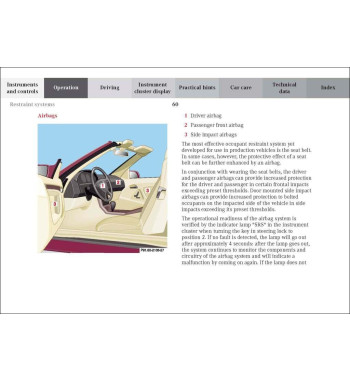
The documentation explains the correct use of the seat belts, emergency tensioning retractors, front airbags and side-impact airbags. It also describes the BabySmart system for detecting a compatible child seat and deactivating the passenger airbag.
Additional guidance covers the roll bar, SRS warning lamps and the precautions required when transporting infants and children.
The manual shows how to lower and raise the soft top, install the wind screen and remove or attach the hardtop. It also covers the panorama roof and explains the manual soft-top closing procedure if normal operation is unavailable.
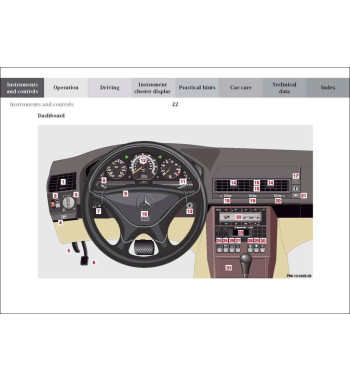
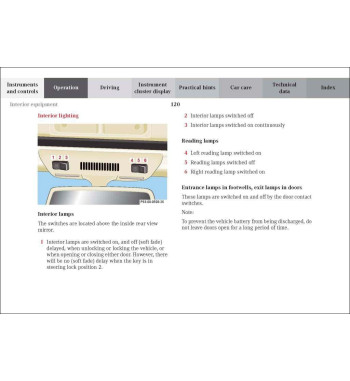
Illustrations identify the switches, attachment points and operating sequences, helping the owner avoid procedures that could damage the mechanism.
The manual also covers the initial break-in period, fuel-efficient driving, braking, parking, tire use and recommendations for traveling abroad.
An important difference from earlier manuals is the inclusion of the Tele Aid system. The documentation explains emergency calls, roadside assistance and the related vehicle-communication functions.
It also identifies warning lamps for the brakes, ABS, BAS, ESP, SRS, engine oil, coolant, battery, exterior lighting, roll bar and adaptive suspension.
These instructions provide useful assistance for routine situations but do not replace workshop-manual diagnostics or repair procedures.
The manual provides specific recommendations for the bodywork, trim, light-alloy wheels, lamps, windows, instrument cluster, steering wheel, seat belts and leather upholstery. It also covers care of the soft top, wind screen, antenna and plastic or rubber components.
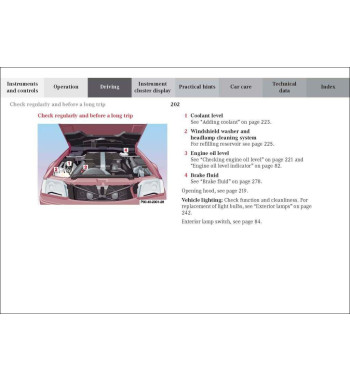
The documentation identifies the vehicle labels and provides information about the engines, transmission, Poly-V-belt routing, electrical system, dimensions, weights, wheels and tires. Capacities and service products are differentiated by engine version.
The engine-oil, fuel, brake-fluid, coolant and air-conditioning-refrigerant specifications reflect the standards applicable when the manual was published and should be checked before modern equivalents are used.
The original manual is organized into the following main sections.