Manual dedicated to the ML 350 and ML 500 versions of the first-generation M-Class. It explains the controls, equipment, on-road and off-road driving, maintenance and principal emergency procedures.
PDF in English | 356 pages | Instant download.

Security payment

Digital delivery

Returns
Cookies: We use necessary cookies for the cart and login to work. You can accept, decline, or configure non-essential cookies.
Owner's manual to learn about the operation, driving and specifications of the Mercedes-Benz ML 350 and ML 500 of the W163 Series.
The first-generation M-Class represented Mercedes-Benz's entry into the modern SUV segment. Its development aimed to combine passenger-car comfort, safety and road behavior with the versatility, interior space and off-road ability expected from a sport utility vehicle.
Built at the Tuscaloosa plant in Alabama, the W163 used a separate frame, independent suspension on both axles and electronically controlled permanent four-wheel drive. Following the mid-cycle update, the range received changes to its design, equipment and engines, including the versions covered by this document.
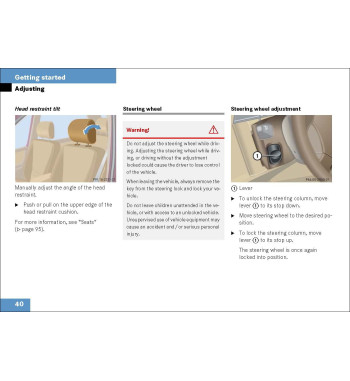
This Operator's Manual helps the owner identify the controls and understand the vehicle systems. It also explains passenger-compartment configurations, cargo use, off-road driving, trailer towing, warning messages and basic owner procedures.
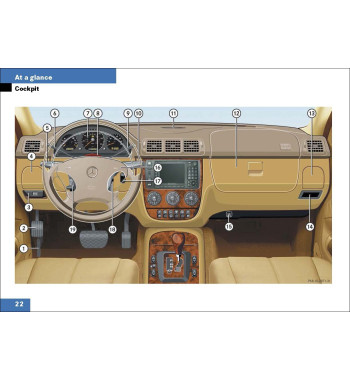
The manual illustrates the cockpit, instrument cluster, center console and overhead control panel. These diagrams help locate the switches and recognize the indicators before driving.
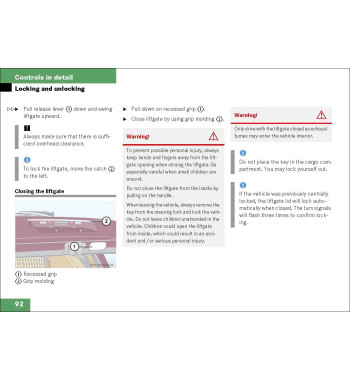
It also explains central locking, front seats, memory functions, head restraints, heated seats and the rear bench. Instructions cover the optional third-row seats and the different passenger and cargo configurations.
The documentation explains selector-lever positions, one-touch gearshifting, gear ranges and emergency operation. It also provides guidance concerning fuel consumption, braking, tires, hydroplaning, winter driving and standing water.
Additional sections cover trailer towing, driving abroad and the correct use of radio transmitters installed in the vehicle.
A dedicated section explains vehicle preparation, route selection and speed adjustment. It covers slopes, descents, uneven surfaces, mud, sand, water crossings and the inspections required after returning to a conventional road.
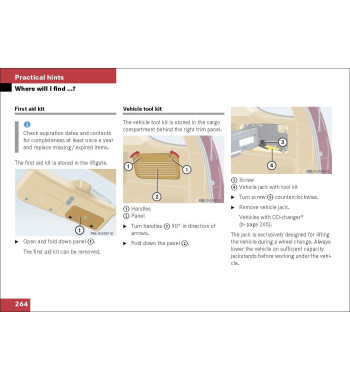
The manual explains how to call up and reset the maintenance service indicator. It also helps interpret warning lamps and messages relating to the engine, brakes, transmission, safety systems, fluid levels and tire pressures.
These instructions provide useful assistance for routine situations and preserve the documentation appropriate to the vehicle. They do not replace workshop-manual diagnostics or repair procedures.
The documentation identifies the vehicle labels and provides specifications for the engines, electrical system, wheels, tires, dimensions, weights and Poly-V-belt. It also lists capacities for each version.
The engine-oil, fuel, brake-fluid, coolant and air-conditioning-refrigerant recommendations should be checked before modern equivalents are used.
The original manual is organized into the following main sections.